![]()
There is a ‘growing’ animal industry that the vast majority of Australians would be unaware of. ‘Ultra-fine’ wool growers supply an elite international market and wealthy buyers from the world’s foremost fashion houses.
Ultra-fine wool growing is an intensive animal industry. In fact, one particular facility which opens its doors to the public, is even appropriately called—‘The Wool Factory’.
And factory it is... Specially bred sheep are kept indoors in individual small pens 24 hours a day for 4 or five years. Nylon coats are worn by the ‘shedded’ sheep to further ensure that dust and dirt does not enter their fleece, and—like every other intensive animal industry—the behavioural and social needs of the sheep, intrinsic factors which provide quality of life, are completely ignored. Some indoor ‘ultra fine’ facilities house the sheep in groups. A welfare assessment of this intensive system is yet to be undertaken.
A major supporter of Australia’s ultra-fine wool industry is leading Italian fashion house, Ermenegildo Zegna. The ‘prestige’ of winning an Ermenegildo Zegna award is much sought after in wool industry circles. The ‘Vellus Aureum Trophy’ is awarded by Count Paulo Zegna each year for the ‘golden fleece’—the finest micron fleece.
Animals Australia Executive Director Glenys Oogjes and Communication Director Lyn White were ‘introduced’ to the sheep that grew the 2005 ‘golden fleece’ during a tour of ‘The Wool Factory’. However, this award-winning sheep, like the other 930 odd Merino-Saxon sheep kept in this indoor facility, had little to celebrate.
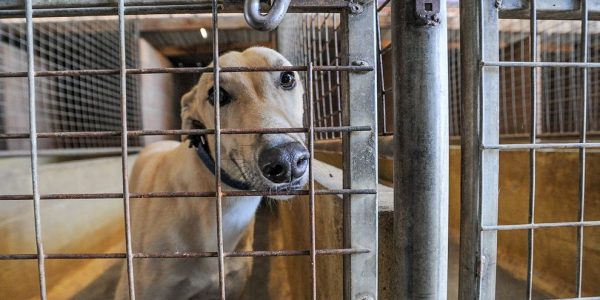
The impacts of chronic stress caused by an inappropriate environment were obvious. The confined sheep continually chew on the wooden slats and strands of wire which enclose them. Repetitive body movements were also observed—classic stereotypic behaviours caused by a barren environment, combined with the inability to exercise, or to perform simple natural behaviours such as graze on grass.
Sheep suffer chronic stress as a result of their inappropriate environment, causing them to continually chew on the wooden slats and strands of wire which enclose them.
Suggestions that these animals are 'better off' living in such confinement—as they are sheltered and have a daily food source—is a desperate defence from those who know they are denying these animals every behavioural need that provides any enrichment in their lives, on the basis of profit.
Requests from Animals Australia for The Wool Factory to permit an expert in animal behaviour to assess the well-being of sheep in The Wool Factory was denied.
Concerns were raised with the Victorian Government Animal Welfare Advisory Committee resulting in a request for committee members to attend the facility to observe the sheep. This too was denied. A request from the Department of Primary Industries to install cameras in the facility to monitor the behaviour of the sheep has also been denied.
Clearly the management of The Wool Factory—despite their protestations that the sheep are happy and healthy—aren’t confident that experts in the field will reach a similar conclusion. Their cruel practices continue and once again they have recently celebrated winning the Zegna trophy.
There appears little doubt that the welfare issues witnessed at ‘The Wool Factory’ (the income from which supports training programs for the disabled) would be replicated at other private ‘ultra-fine’ facilities, where sheep are also individually penned.
The sheep Code of Practice states that animals that are unable to adapt to the indoor confinement should be returned to grazing. Clearly from the evidence gathered at The Wool Factory, this is not occurring. If operators are not complying with the Code of Practice they can be prosecuted for cruelty under state animal welfare laws.
The majority of shedded sheep operations are in Victoria.
Please write to the Victorian minister and ask him to ensure that there are regular inspections of intensive sheep facilities and to prosecute operators for cruelty who are not returning sheep to grazing that are not coping with the environment:
Hon. Joe Helper MP
Minister for Primary Industries and Agriculture
Parliament House
Melbourne. Vic. 3000
Write to Ermenegildo Zegna—the firm primarily encouraging ultra fine wool growing through offering 'prestigious' awards and ask them to withdraw their support for animal cruelty:
ERMENEGILDO ZEGNA AUSTRALIA PTY. Ltd.
Head Office - Showroom:
Level 9, 85 Queen Street
Melbourne, VIC 3000
Phone/Fax: 03 9672 5000
Australian stores/outlets:
Ermenegildo Zegna Boutique:
Melbourne: 161 Collins Street, MelbourneErmenegildo Zegna Boutique:
Sydney: 201, Macquarie Street (cnr Martin Place)
David Jones, 500 Oxford Street, Bondi
Adelaide: David Jones – 100 Rundle Mall
Brisbane: Joe Richards, 743, Stanley Street, Woolongabbah