Credit: Farm Transparency Project
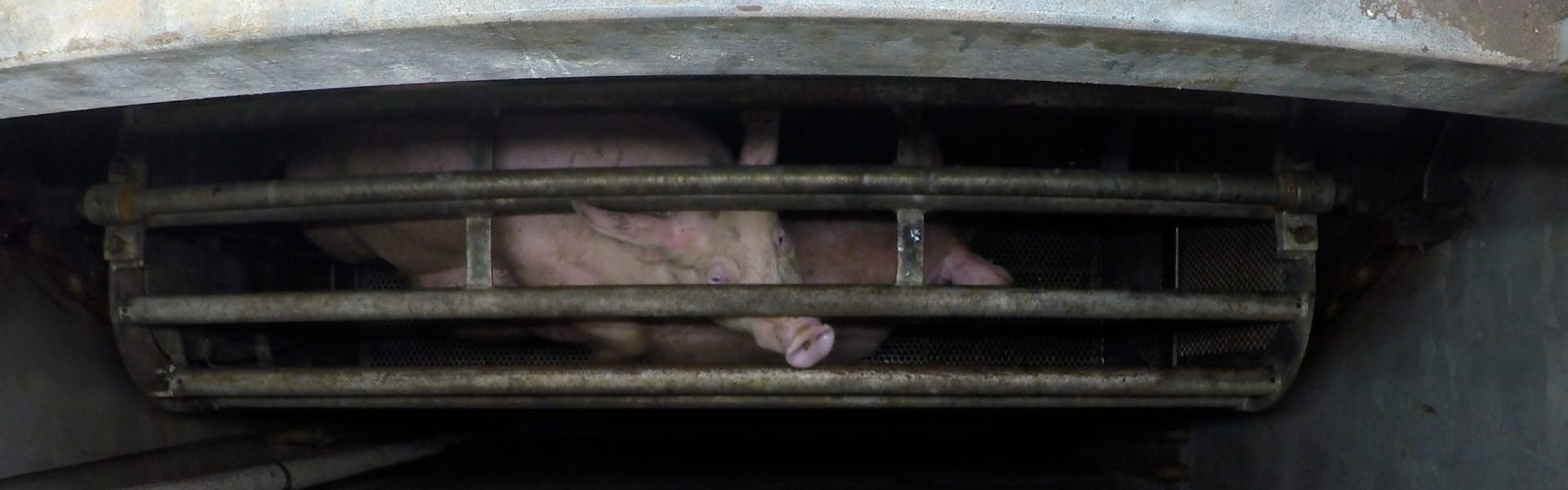
Pigs being lowered into a gas chamber in a Victorian slaughterhouse.

How are animals slaughtered in Australia?

Australians care about protecting animals from cruelty. But most have never seen inside a slaughterhouse...

Animals Australia

Animals Australia team

Last updated August 5, 2025

How much do we really know about the life – and death – of the animals who are bred and killed for food in this country?

Many people are shocked to learn that farmed animals have been deliberately excluded from the same laws that protect our companion animals – allowing cruel and outdated practices to continue in the interests of economic efficiency.

This image contains content which some may find confronting

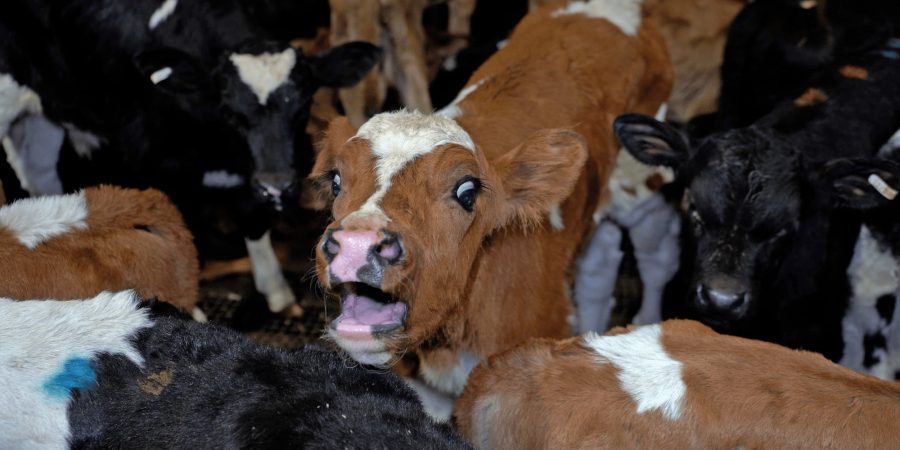
A scared calf bellowing, their mouth wide open and the whites of their eyes showing.
It's legal to treat Australian farmed animals in ways that would be considered criminal cruelty if done to a companion dog or cat.
Image credit: Farm Transparency Project

The reality is that there is no such thing as humane slaughter. Even the ‘best case scenario’ as outlined below, will subject animals to prolonged stress and suffering during transport, and pain and terror at the slaughterhouse.

Pigs

More than 5 million pigs are killed for their meat in Australia every year. The vast majority of them will spend their final moments gasping for air and some thrashing in terror inside a gas chamber. This is not only legal, but the ‘best’ method the pig meat industry has come up with to slaughter pigs.

Investigators from the Farm Transparency Project have bravely captured shocking footage of this routine pre-slaughter practice used in Australia today – and what it looks like for the pigs forced to endure group gassing. Airing in a special report onABC’s 7:30 Program, the final, painful moments of sensitive pigs revealed the true cost of pork, bacon and ham products.

This is how it works: a small group of pigs is herded into a steel cage (called a gondola). The cage is then lowered into a deep chamber filled with carbon dioxide. As their nostrils, throats and lungs begin to burn from the high intensity of gas, the pigs become distressed. Many scream and struggle for up to thirty seconds until they eventually collapse unconscious. Finally, they are tipped out onto a bench, hung from shackles, and their throats are slit.

Whether factory farmed or free-range, this is how most pigs in Australia are killed.

It was in 2014 that the highly distressing routine gassing of pigs was first exposed inside Australia’s biggest pig abattoir. Although group gassing is claimed to be the most ‘humane’ method of rendering pigs unconscious before slaughter, what was revealed through this investigation however was that the Australian meat industry standard requires a carbon dioxide concentration at least four times higher than what is scientifically known to avoid distress. A Co2 concentration above 30% is extremely painful for the pigs; in Australia, the industry standard is between 80 and 90%, to have the kill line move as quickly as possible.

Incredibly, despite industry promises of reform, little has changed since these shocking practices were exposed almost a decade ago. What this means is that while Australian laws require animals to be rendered unconscious prior to slaughter to at least reduce suffering – the routine process of rendering pigs unconscious is one that causes abject pain and, for some pigs, terror.

Some small abattoirs use electrical stunning for younger pigs, placing a device on either side of the pig’s head to send a charge across the brain to induce unconsciousness. Breeding sows and boars who are normally slaughtered at a few years old when their ‘productiveness’ wanes, will usually be subjected to electrical or captive bolt ‘stunning’, before their throats are cut.

Cows, young calves, and sheep

For most animals, the stress of the slaughter process begins well before they reach the slaughterhouse. This is especially true for sheep and cattle. They can be mustered, yarded, loaded and unloaded (sometimes more than once), and transported hundreds or even thousands of kilometres across the country if saleyard or abattoir prices are better in one state than another.

Australian laws, regulations and monitoring are woefully lacking when it comes to safeguarding the welfare of farmed animals during transport to slaughter. Legally, these animals can be deprived of food and water for up to 48 hours but for most journeys there is no requirement to record the last time they had access to these basic needs.

The situation is equally dire for dairy calves discarded from the dairy industry. These babies – purposefully bred only to keep their mothers producing milk – will be trucked to a slaughterhouse at just 5 days old and can legally be denied food for up to 30 hours between the last farm milk feed and slaughter at the abattoir.

This image contains content which some may find confronting

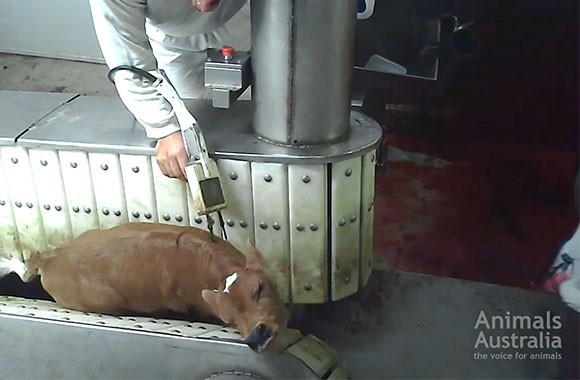
Undercover footage still of a young dairy calf being stunned before slaughter.

The stresses of transport and handling accumulate throughout the journey and are further exacerbated upon arrival at the slaughterhouse where animals are surrounded by unfamiliar sights, sounds and other animals outside their normal social groups.

Once at the slaughterhouse, sheep and cattle will normally be killed within 24 hours. Australian laws require animals to be ‘stunned’ unconscious prior to having their throats cut. For cattle, this is normally done using a device called a ‘captive bolt gun’ which delivers a forceful strike to the forehead to induce unconsciousness. Sheep and dairy calves are mostly subjected to an ‘electrical stunning’ device that sends an electric current across the brain, rendering them unconscious.

This is the fate of a staggering 31 million sheep and 8 million cattle every year in Australia.

What happens to sheep, cows and dairy calves when things ‘go wrong’?

Every slaughterhouse is under pressure to kill as many animals as possible in the shortest time. Inevitably, this rush to push fearful and often resistant animals along the slaughter line quickly can lead to ‘mistakes’ being made.

The cattle slaughter industry’s permitted re-stunning rate of up to 5% means 5 in every 100 animals (equating to thousands every year) may not be rendered unconscious at the first attempted bolt to the head, but a facility would still pass its audit. In sheep slaughter facilities, it is accepted that the electric stunning tongs may be incorrectly applied up to 2% of the time (prolonging the suffering of hundreds of thousands of sheep every year), and again, this would receive a ‘pass’ by auditors. Awaiting re-stunning would be incredibly painful and distressing for thousands of farmed animals every year.


Chickens

The average Australian eats 25 chickens each year – meaning 635 million chickens are slaughtered for their meat annually in this country alone. This requires dozens of slaughterhouses to kill millions of birds a day.

For these animals, the ordeal begins the night they are collected from the farm. Sheds can be filled with tens of thousands of chickens. They will be picked up by ‘catchers’ with four to five live birds upside-down in each hand (as the industry standard allows) and shoved into transport crates. The body of a ‘meat’ chicken has been engineered to grow so unnaturally large that their skewed proportions make them more susceptible to injuries during this process, which is called ‘de-population’.

The capturing process is fraught for egg laying hens too, who are normally slaughtered at 18 months of age when their egg production wanes. After over a year of constant egg laying, their bodies are slight and fragile so rough handling during de-population can result in damage to their wings or broken or dislocated hips and legs.

At the slaughterhouse, some birds (‘meat’ chickens) will be placed in Co2-filled chambers and killed or gassed unconscious, before having their throats cut. At many other slaughterhouses, birds may be shackled into ankle cuffs on a conveyor belt while fully conscious. They can be left hanging upside down for several minutes — a position which would cause great pain for animals who have been bred to be as heavy as possible, not to mention that many already suffer from weak and underdeveloped joints, or even broken bones.

From there, the suspended conveyor line moves, and the birds’ heads are dipped through an electrified-water stunning bath. The production line moves on, and the birds have their throats cut open by a spinning blade. They’re assigned a few minutes to bleed to death before being dunked into scalding tanks of boiling water which are designed to remove their feathers.

What happens to chickens when the slaughter process ‘goes wrong’?

‘High throughput’ slaughterhouses operate on strict time schedules and, as investigations have revealed, there is often little opportunity – or incentive – to avoid individual animal suffering.

Terrified animals may swing their heads out of the way of the electrified bath, the mechanical blade and ‘back up’ slaughterman. Others don’t fully ‘bleed out’ in the allotted time. These birds – who aren’t dead by the time the conveyor belt they’re shackled to reaches the scalding tanks – will be dragged alive into boiling water, as exposed in a shocking investigation by photographer Tamara Kenneally and revealed on the ABC.


Animals are slaughtered without effective independent monitoring

There is a frightening lack of government oversight in Australian slaughterhouses, especially when you consider that they handle and kill hundreds of millions of vulnerable animals each year.

Time and again, investigations have revealed the risks animals face when no one is watching. And it’s not just the animals who suffer – slaughterhouse workers suffer too.

Thankfully, there’s a kinder choice

Sir Paul McCartney famously said that if slaughterhouses had glass walls, the world would be vegetarian. He understood that humans innately care about other sentient beings and don’t want to see them being harmed.

The demand for ever-cheaper meat, milk and eggs, has led to the factory farming practices and industrialised slaughter of animals that exist today. These systems treat animals like ‘product-producing’ machines, instead of the sensitive individuals they are. But consumers are rarely told about, or shown, the reality farmed animals face.

The good news is, the power is in each of our hands to shift this demand. Every time you choose a plant-based meal over an animal-based one, you are helping to transform our food system and shape a future where animals are seen as someone, instead of something. And choosing to eat kindly has never been easier or more delicious…

Order your free guide to kinder eating today. Nearly there! Thank you ! Thank you!

, tell us where to send your free guide tell us where to send your free guide Thank you for dreaming a new dream, and for paving the way to a kinder, more compassionate world.
Veg Starter Kit Booklet cover
This magazine is packed with animal-friendly recipes, nutrition tips, and more!
* Indicates required field.

Your details are safe, refer to our Privacy Policy

Search for your address and select from the dropdown.
Orset your address manually.
Enter your building details, street number and name. E.g. Unit 1, 100 Smith Street

Submitting your details...

Your details are safe, refer to our Privacy Policy

Keep an eye out for your free magazine in the mail, it will be with you soon. Help us spread the word!

CONTENT WARNING
This page contains graphic content which some may find upsetting.